



Hey there! As a supplier of SAE100 R5 hydraulic hoses, I often get asked about the burst pressure of these hoses. So, I thought I'd take a few minutes to break it down for you.
First off, let's talk about what SAE100 R5 is. SAE100 R5 is a type of hydraulic hose that's commonly used in low - pressure applications. It's a single - wire braid hose with a synthetic rubber cover and tube. These hoses are known for their flexibility and durability, making them a popular choice in various industries.
The burst pressure of a hydraulic hose is a crucial factor. It refers to the maximum pressure that the hose can withstand before it fails catastrophically. In simpler terms, it's the point at which the hose bursts. For SAE100 R5 hoses, the burst pressure is typically four times the working pressure.
The working pressure of SAE100 R5 hoses usually ranges from around 800 to 1200 psi (pounds per square inch), depending on the specific size of the hose. So, if we do the math, the burst pressure can be anywhere from 3200 to 4800 psi.
Now, why is it so important to know the burst pressure? Well, in any hydraulic system, things can go wrong. There could be sudden pressure spikes due to equipment malfunctions or rapid valve closures. If the pressure in the system exceeds the burst pressure of the hose, it can lead to a dangerous situation. A bursting hose can cause fluid leaks, which not only create a mess but can also be a safety hazard. It can spray hot hydraulic fluid, which can burn people and damage surrounding equipment.
When you're choosing a hydraulic hose for your application, you need to consider the burst pressure along with other factors like the working pressure, the type of fluid being carried, and the environmental conditions. For instance, if you're using the hose in an area with high temperatures, the burst pressure might be affected. High temperatures can cause the rubber in the hose to degrade over time, reducing its strength and potentially lowering the burst pressure.
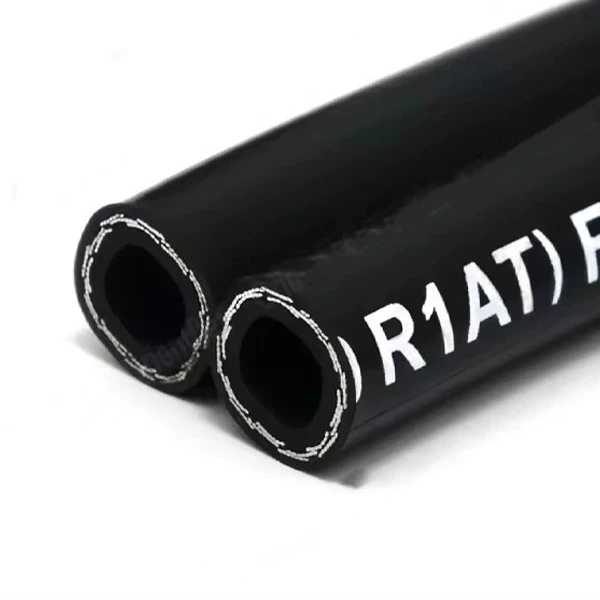
Let's compare SAE100 R5 with some other popular hydraulic hoses. Take the SAE100R1AT for example. SAE100R1AT is also a wire - braid hose, but it's designed for higher - pressure applications. Its working pressure can be much higher than that of SAE100 R5, and so is its burst pressure. The burst pressure of SAE100R1AT is also typically four times its working pressure, but since the working pressure is higher, the burst pressure will be significantly higher as well.
Another comparison is with Din En857 2sc and Din En857 1sc. These European - standard hoses have different construction and performance characteristics compared to SAE100 R5. Din En857 2sc is a double - wire braid hose, which generally means it can handle higher pressures. Its burst pressure will be higher than that of SAE100 R5 because of the additional layer of reinforcement. On the other hand, Din En857 1sc is a single - wire braid hose like SAE100 R5, but the materials and manufacturing standards might be different, resulting in different burst pressure ratings.
As a supplier of SAE100 R5 hoses, I always make sure to provide accurate information about the burst pressure to my customers. We test our hoses rigorously to ensure that they meet or exceed the industry standards. Our testing process involves subjecting the hoses to increasing pressure until they reach the burst point. This way, we can guarantee that the burst pressure we claim is reliable.
We also offer a range of sizes and configurations of SAE100 R5 hoses to meet different customer needs. Whether you need a short hose for a small - scale project or a long one for a large industrial application, we've got you covered.
If you're in the market for SAE100 R5 hoses, it's important to choose a reliable supplier. You want someone who can provide you with high - quality hoses that have accurate burst pressure ratings. And that's where we come in. We've been in the business for years, and we have a reputation for delivering top - notch products.
If you have any questions about the burst pressure of SAE100 R5 hoses or if you're interested in purchasing our products, don't hesitate to reach out. We're here to help you make the right choice for your hydraulic system. Whether you're a small business owner or part of a large industrial operation, we can work with you to find the perfect hoses for your needs.

In conclusion, understanding the burst pressure of SAE100 R5 hoses is essential for the safe and efficient operation of your hydraulic system. It's not just a number; it's a critical factor that can prevent accidents and costly downtime. So, if you're looking for high - quality SAE100 R5 hoses with reliable burst pressure ratings, give us a shout. We're ready to start a conversation and help you with your procurement needs.
References:
- Hydraulic Hose Handbook by Parker Hannifin
- Industry standards for SAE100 R5 hoses