

Latest Products


Contact Us
- Lijiacao Industrial Park, Cheng Yang District. QingDao City, China
- service@lomoflex.com
- +8613863960269
Why Choose Us
Professional Technical Team
We have 10 engineers and quality inspector have 20 years work experience. This provides a reliable quality assurance for our products. We have R&D team with capability of indenpendently researching, designing, and developing hydraulic systems to meet different customization demandsWorking with simple and complex hydraulic applications, you will always have special needs.
Wide range of applications
Our factory is committed to developing and manufacturing hose fittings, hydraulic fittings, hose assemblies and other related products that are widely used in mining, machinery, transportation, ships, oil fields and other fields. Is a leading manufacturer and supplier of hydraulic hose fittings in China.
Customization
Our R&D and Engineering team will support your customization needs by understanding your ultimate goal; designing, practicing, and testing the solution before delivery; We provide service and solution tailored to your needs. We make it happen, from an "idea" to an "application". Or alternatively, we welcome your drawings and designs. We relying on our experience, will study and improve to make it best suit your needs.
Professional service
We follow a strict manufacturing and service concept, that is; "quality first, stick to integrity" coupled with a "second to none" service department which bolsters excellence and quality known around the world. We strive everyday to keep our reputation as a "first-class" enterprise.
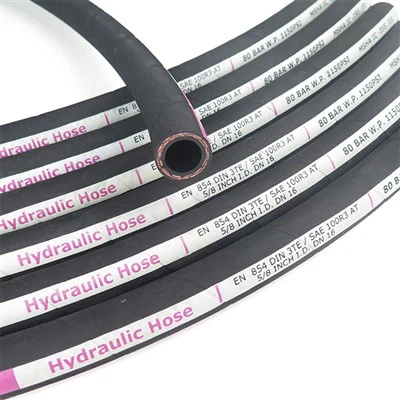
A textile braid hose is one of the types of hydraulic hose that is made up of several layers of fabric or yarn. The inner layer of the hose is typically made from a synthetic rubber material, while the reinforcement layer is made from a woven textile material. The layers are then bound together using a special adhesive or vulcanization process. The result is a hose that is strong, flexible, and durable. Compared with the wire-reinforced hose, textile braiding reinforced hydraulic hoses are designed to be used for medium to low-pressure working conditions for hydraulic hose applications.
 Din En854 1te Or Sae 100 R6
Construction of SAE 100 R6. Tube: oil resistant synthetic rubber.. Reinforcement: one high tensile textile braid.. Cover: abrasion, ozone, and hydrocarbon resistant synthetic rubber.. Constant
Add to Inquiry Din En854 3te Or Sae 100 R3
Construction of SAE 100 R3. Tube: oil resistant synthetic rubber.. Reinforcement: two high tensile textile braids.. Cover compound : abrasion, ozone and hydrocarbon resistant synthetic rubber..
Add to Inquiry
Benefits of Textile Braid Hose
Textile braid hoses are essential tools in industries that rely on secure and leak-free hydraulic hose connections.
Reliable and secure connections: Textile braid hoses create strong and reliable connections that withstand high-pressure hydraulic applications, minimizing the risk of leaks or failures.
Time and cost efficiency: Crimping hoses in-house with a textile braid hose saves time and money by eliminating the need for outsourcing or using alternative connection methods like clamps or fittings.
Customization and flexibility: Textile braid hoses allow for on-demand hose assembly production, enabling customization in terms of hose length, fitting types, and sizes, providing flexibility to meet specific application requirements.
Applications of Textile Braid Hose
Textile braid hoses, often referred to simply as braided hoses, are a versatile and essential component in various industries and applications. These hoses comprise of a flexible inner tube surrounded by a woven or braided stainless steel outer layer. This construction provides unique properties, making them suitable for various applications where strength, durability, and flexibility are crucial.
Textile braid hoses are widely used in the automotive and transportation industry for various applications. One common use is in brake systems, where the textile braid hoses provide maximum strength and flexibility, ensuring reliable and efficient braking performance. These hoses are often found in fuel delivery systems, which help maintain a steady fuel flow from the tank to the engine. The steel braiding protects against abrasion and punctures, reducing the risk of leaks and potential hazards.
The Importance of Textile Braid Hose Size



Flow is the movement of fluid and is broken down into two categories: flow rate and flow velocity. Flow rate is the volume of hydraulic fluid produced by the hydraulic pump over a specific amount of time and is commonly measured using gallons per minute or GPM. Flow velocity is the speed at which hydraulic fluid travels in a certain direction over a specific amount of time and is measured using feet per second.
Flow velocity is determined by both the hydraulic pump's flow rate and the textile braid hose size. Changing the flow rate of the hydraulic pump but leaving the textile braid hose size the same will affect flow velocity. In contrast, keeping the flow rate the same but changing the hose size will affect flow velocity.
Flow velocity is an important consideration when replacing a larger textile braid hose ID with a smaller textile braid hose ID. When an existing textile braid hose is replaced with a new textile braid hose that has a smaller ID, the same amount of fluid that was flowing through the original, larger textile braid hose is now forced through the new, smaller hose. This will restrict flow and increase downstream pressure, thus causing flow velocity to increase.
In some situations, this might not be a problem, so it is important to properly analyze the situation. An easy option to avoid this problem is to size-up to the next larger textile braid hose size. However, larger hoses usually come with a higher price, plus larger textile braid hoses take up space and could even decrease the customer's equipment performance.
A textile braid hose is critical for ensuring your machinery works as designed. The hose helps to provide the leverage needed to make heavy mechanical systems work. Like virtually all components of modern machinery, a textile braid hose does not last forever. You might wonder: Why perform textile braid hose maintenance? The following should answer that question.
Make your equipment last longer
Maintaining hydraulic lines helps to ensure your equipment will work well and last as long as possible. Hydraulic systems put relatively little wear and tear on heavy equipment while greatly enabling your equipment to perform more work. When your hydraulic lines are in good condition, so is your heavy equipment.
Safety benefits of hydraulic hoes maintenance
A hydraulic line failure could be very serious and highly dangerous for workers. A sudden failure might cause your heavy equipment to drop a heavy load that could land on one or more workers or damage other equipment. A bad textile braid hose also might leak fluid that might cause one or more workers to slip, fall, and suffer an injury.
Prevent fire hazards
Hydraulic fluid is flammable and could cause a flash fire if a hose were to fail and leak fluid. The fluid might leak onto an exhaust manifold, electrical wires, or maybe just a piece of equipment that occasionally causes sparks.
Just one ignition source might cause a catastrophic fire. Regular inspections, maintenance, and repairs as needed will help to ensure your hydraulic system is fully contained and will not cause a fire or any other problems.
Stop air and water from entering the system
When air gets into a hydraulic system, it weakens the hydraulics and could render the system useless. That is because the air compresses instead of sending the pressure within the system to where it is supposed to go.
Poorly maintained hydraulic lines might develop hairline cracks and weakened connectors that enable air to enter the system. It also could let moisture collect and reduce the effectiveness of the hydraulic system.
Maintain productivity throughout the work day
When you have good hydraulics, your heavy equipment is less likely to fail. A good hydraulic system will enable your workers to keep doing their jobs while getting the most work done each day.
Bleeding the hydraulic lines after checking them for cracking, splitting, and other defects will help to make it work as well as possible and keep your worksite as productive as possible.
How Are Textile Braid Hoses Made?
The process of making a braided textile hose involves several steps.
First, the inner layer of the hose is created by extruding synthetic rubber material into a tube shape. Next, the textile material for the outer layer is woven into a tube shape. The two tubes are then bonded together using a special adhesive or vulcanization process. The resulting hose is then tested to meet the required specifications.
Here is a step-by-step process for making textile braid hoses:
Fiber selection: The first step in making a textile braid hose is selecting the appropriate fibers to use. Synthetic or natural fibers such as polyester, nylon, or aramid are typically used for their strength and durability.
Braiding: The selected fibers are then woven together using a specialized braiding machine. The machine may use different patterns or weaves to create the desired level of strength and flexibility in the hose.
Inner tube installation: After the braiding process, an inner tube made of rubber, plastic, or other materials are inserted into the braided fibers. This inner tube provides a smooth, non-porous surface for fluids to flow through and helps reinforce the hose.
Cover application: A cover layer is then applied to the hose to protect it from abrasion, weather, and other environmental factors. This cover layer may be made of materials such as neoprene, pvc, or polyurethane.
Curing: Once the cover layer has been applied, the hose is cured to ensure that the materials bond together properly. This may involve subjecting the hose to high temperatures or pressure in a specialized curing chamber.
Testing: After the hose has been cured, it is tested to ensure that it meets the manufacturer' s specifications for quality and performance. This may involve subjecting the hose to high pressures or temperatures to check for leaks or other issues.
What Are the Common Materials of Textile Braid Hose?
Rubber
Most hydraulic hoss are made from rubber, either synthetic or natural. Rubber offers excellent flexibility, durability, and resistance to abrasion and chemicals. It is also easy to mold and shape into different sizes and shapes.
01
Thermoplastics
Thermoplastic materials, such as nylon, polyurethane, and pvc, are increasingly being used in textile braid hoses. These materials offer high resistance to abrasion, chemicals, and temperature changes. They are also lightweight, flexible, and easy to install.
02
Teflon
Teflon is a synthetic material that offers excellent resistance to chemicals, high temperatures, and corrosion. Teflon textile braid hoses are commonly used in applications involving aggressive chemicals or extreme temperatures.
03
Metal
Metal hoses, made of stainless steel or other alloys, are used in applications that require high-pressure and high-temperature resistance. They are also used in applications that require resistance to abrasion, vibration, and shock.
04
Composite materials
Composite hydraulic hoss are made of a combination of materials, such as rubber, thermoplastics, and metal, to offer a balance of properties such as flexibility, strength, and resistance to abrasion and chemicals.
05
Our Factory
About LOMOFLEX CO., LTD founded in 2011. Our factory is committed to developing and manufacturing hose fittings, hydraulic fittings, hose assemblies and other related products that are widely used in mining, machinery, transportation, ships, oil fields and other fields. Is a leading manufacturer and supplier of hydraulic hose fittings in China.
At our "state-of-the-art" manufacturing facility, our factory specialize in producing many kinds of hydraulic hose, industrial hose, hose reinforcement steel wire and hose fittings Etc. We have 10 engineers and quality inspector have 20 years work experience. This provides a reliable quality assurance for our products. We also export to many countries and regions such as North America, South America, Europe, Southeast Asia, the Middle East, Africa and other strategic locations world-wide.
Our number one goal is to provide the highest quality products with top-notch customer service.
We follow a strict manufacturing and service concept, that is; "quality first, stick to integrity" coupled with a "second to none" service department which bolsters excellence and quality known around the world. We strive everyday to keep our reputation as a "first-class" enterprise.
Ultimate FAQ Guide to Textile Braid Hose
Q: How often should you change textile braid hoses?
Q: How do I know if my textile braid hose is bad?
Q: What size textile braid hose should I use?
Q: Can a textile braid hose be used for water?
Q: In which industries is textile braid hose widely used?
Q: Is textile braid hose important?
Q: Is textile braid hose wear-resistant?
Q: Do textile braid hoses get longer under pressure?
Q: Does textile braid hose size matter?
Q: Is textile braid hose measured by ID or OD?
Q: What are the criteria for textile braid hose selection?
S = Size.
T = Temperature.
A = Application.
M = Material.
P = Pressure.
E = Ends or couplings.
D = Delivery (volume and velocity)
Q: Which of the following must be considered when selecting textile braid hose?
Q: Which factor is crucial when selecting a textile braid hose for a specific application?
Q: How do you determine the size of a textile braid hose?
Q: How are textile braid hoses rated?
Q: What is the use of textile braid hose?
Q: What is textile braid hose?
Q: Why do textile braid hoses fail?
Q: Can textile braid hoses be bent?
Q: Can you repair a textile braid hose?
Q: What is the difference between single and double textile braid hoses?
As one of the most professional textile braid hose manufacturers and suppliers in China, we're featured by quality products and competitive price. Please rest assured to wholesale textile braid hose in stock here and get quotation from our factory. Contact us for customized service.
oil resistant textile braid hose, chloroprene rubber hose textile braid, hypalon hose textile braid